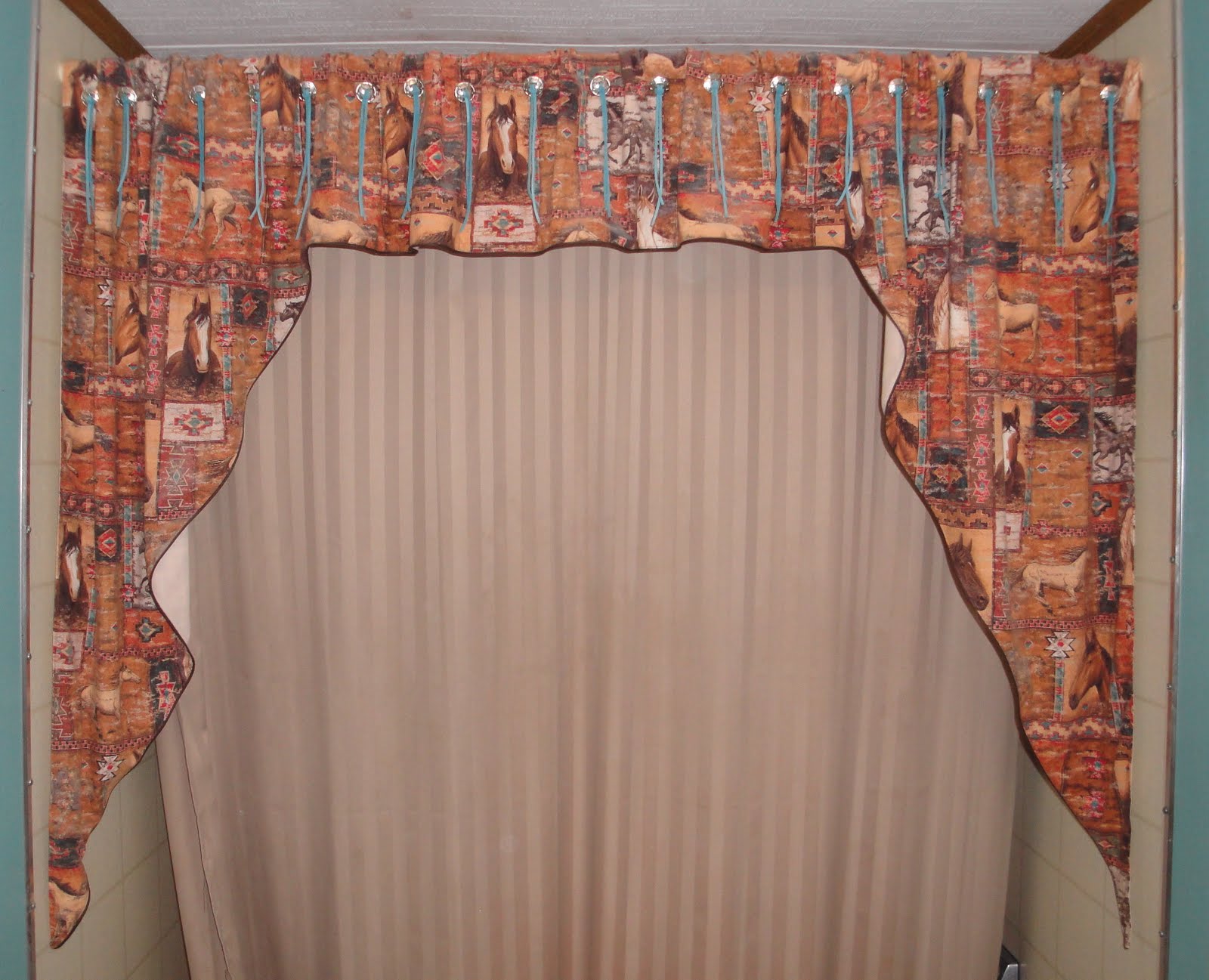
How to make curtains, curtains design, curtain needs, curtain styles

Showing posts with label Valances. Show all posts

Thursday, August 13, 2015

Valances, Cornices, Swags (Valances)

Valances

Valances, Cornices, Swags (Valances)
Stiffened valances seem to go in and out of style. Just a few years ago a formal valance was considered very old-fashioned, but today with increasing use of elaborate period decor, the more formal valances are good once more. This also holds for the draped valance with jabots, a treatment most adaptable to formal rooms using satins, taffetas, and other rich fabrics.

A valance board is very easily constructed by mounting a shelf about 3/8 % inch thick and four inches wide on a 4 inch metal corner, which is fastened to the wall with screws or toggle bolts.

To make a stiff valance, cut a pattern the width of your window from a piece of stiff brown paper or muslin. Make it as deep as you think correct, remembering that deep valances cut down the appearance of height and may seem overwhelming in a small room. The usual depth is from one-sixth to one-eight the length of your draperies.

Fold at the center to make the curve symmetrical; if you want a curved valance, make the curve deeper at the center and cut a graceful swirl. With your paper pattern as a guide cut your buckram or canvas stiffening the same size and shape. Cut the side piece the width of the side of your shelf, or valance board. Bind the raw edges of the buckram so they won't pierce the fabric of the covering later. Place this buckram pattern on your fabric and cut around it, leaving about an inch-wide border all around, that you will later turn over. You can then cut a matching piece of cotton padding, although this is optional, and a matching piece of sateen lining, the size of your buckram pattern. Lay all together, placing the fabric right side up, the lining right side down, and the stiffening on top. Stitch along the lower edge, and turn so that the stiffening lies in between. Overcast the top and ends, tucking in the raw edges as you sew.

Valances, Cornices, Swags (Valances)
A welting along the edge of a shaped valance increases the look of good tailoring. Baste the welting between the fabric and the lining before machine stitching all the layers together. The welting should be turned so the round edge is inside and all the raw edges outside, in order to have it fall correctly when it is turned right side out. Another finish for this type of valance is a moss fringe, applied along the front four edges to give a boxy look.

Sew a strip of twill tape across the back of the lining with strong thread, and then use this tape to tack the valance to the valance board with wood snappers or thumb tacks.

You can use a rod instead o a valance board for a softer effect, using a plain rod or a double rod on which your curtains hang, too. In this case you leave a slot or opening for the rod to pass through, or provide a casing with heading as for a curtain. For a gathered or shirred valance of this type make the valance about twice the length needed for the width of the window. Double the depth needed, and add a seam allowance. Crease the material down the center and fold on the crease lengthwise, turning the right sides together. Sew one side and the top, leaving an opening large enough for your rod to pass through at each side, near the top. Turn inside out, so that the fabric is now on the right side on both front and back, and sew the remaining side. Then seam a casing for the rod. When adjusted to the rod this should result in a generously shirred valance, with heading.

Ruffled valances may hang from a rod in much the same manner. If you wish to have two or three rows of ruffles, apply them to a plain foundation of muslin or sateen, made in the same manner as a plain valance.

Valances, Cornices, Swags (Valances)
The pleated valance is made in the same way as a regular plain valance, except that you must allow at least a full length more of material for the width. Take the width of your valance and allow another full length for pleating. Allow sufficient fabric at each end for a seam and for the sides. That is, if your valance is to be 36 inches, your fabric should be 72 inches wide. From that width, subtract the width of each side (let us say they are each 3 inches deep). This leaves 66 inches for pleating, and means that 30 inches of pleating can be used in the pleats. It is clear that the length of the fabric allowed for each pleat must be twice what you wish the pleat to be. If in our assumed valance we wish to have 10 pleats, by dividing 10 into 30, we have 3 inches to use in each pleat, and each pleat can be one-half of 3 inches deep, or 1% inches.

Next divide the numbered pleats into the width of the valance. This will give us the distance between each pleat In our valance this would mean dividing 36 by 10, or 3%th inches between pleats. The first and last pleats will be at the corners of the valance. After pinning the first pleat at top and bottom, the center of the next pleat will be equal to one-half the width of the pleat plus the distance we have already found necessary to leave between pleats.


Fold the pleats in on the pin marks, pressing them as you fold them. Then stitch them so that the folded edges facing one another are caught firmly together, and to reinforce this make two rows of stitching across the back of the entire valance. Hooks for attaching this type of valance to a cornice board can be sewn into the stitching reinforcing the pleats. 

Wednesday, April 15, 2015

Valances, Cornices, Swags and that Built-in Look

Valances, Cornices, Swags and that Built-in Look
Today when a smooth, unified look is one of the things we expect from a good room, built-in bookcases, desks, and even furniture, are designed to suit it. We attempt to make furnishings seem so natural to the room that they are actually part of its architecture. Curtains and draperies help to achieve this smooth-flowing atmosphere, and when they too appear to be built in, the feeling is enhanced. Cornices and valances go a long way towards uniting the drapery with the wall, relating the window to the rest of the room.

They not only conceal the mechanics of the drapery operation, the rods and hooks, and the window frame itself (which is apt to be anything but ornamental in an older house or apartment), but they unite two or more windows, making them seem one large unit, and they can be used decoratively to echo a color or wallpaper or fabric pattern in the room. As they are, in a way, part of the architecture of the room, they must be used judiciously.

You can actually use your wall paper to cover a wood or metal cornice or valance board, or you can cover the boards with a correlated drapery material. Many firms are now producing wallpapers and fabrics in exact duplicates, and some fabric houses have groups of three correlated fabrics so that you can match your valance and drapery in complementary colors and weaves.

Other ideas include mounting a group of small framed prints or photographs on your valance; using stripes on a bias to match vertically striped draperies; using the expensive fabric you could not afford for draperies in your valances; covering them with the new wallpapers that simulate marble, brick, etc. If you make a hobby of finishing woods, you might give an interesting wood finish to a plain pine cornice.

You can buy unpainted hardwood cornices and valance boards at the hardware counter of the drapery section of your department store. Some stores even have assembled cornices with traverse rods installed.

If you buy a ready-made cornice, it is safest to get an adjustable one.

Valances, Cornices, Swags and that Built-in Look
Just to make things clear, valances, cornices and swags are variations of the same thing, the top finish of the window. A valance may be either hard or soft, depending on whether it hangs from a wooden board or not. When it is a curving piece of material with draped ends it is a swag, and when a swag is held at either corner by rings it is a festoon. A cornice is  usually a valance of straight rectangular shape with the board parallel to the window whereas the valance board is at right angles to the window like a shelf. Valances are often used to make a tall window seem shorter, and to make a high ceiling lower. Swags provide color contrast and interest to draperies without headings.

If you or your husband is at all handy with carpentry tools, it is simple enough to make your own cornice, however, since you need only nail together three boards, each about % inch thick. The two side boards will be about 6 inches long, the front board the width you wish the cornice to be. If you want to make your cornice adjustable, take 3 boards for the front piece, and nail them together with the center one on top, and overlapping the other two. To make the cornice shorter, increase the amount of overlapping. Decrease it to make it longer, pulling out the nails. Cornice brackets for attaching the cornice, or valance, to the wall, may be bought in hardware stores and many stores carry them. One part of the bracket plate is attached to the wall; the other to the cornice, and a screw fits through holes in each.  

Friday, November 15, 2013

Window Treatments and Decorating Tips

FESTOONS
The number of festoons depends on the width of the window. In Williamsburg, where most windows are only 3 1/2 feet wide, there are two festoons, each of two feet or less (festoons may overlap).

The number of folds in the festoon determines the degree of formality; many folds convey depth and richness while few folds give a sense of lightness.


CURTAINS
Floor-length curtains are always elegant and formal, while hangings to the window sill are informal and at the same time functional, for they keep the curtains away from the floor in an area much used, or difficult to clean.

The most pleasing curtain effects are given by 100% fullness, which means that curtain width should be double that of the window. Most fabrics measure approximately 54 inches; a pair of curtains for a window four feet wide, therefore, requires two widths, one for each curtain.

VALANCES
Valances are subject to many variations. An elaborately shaped and deep valance like the one illustrated, which is in the dining room of the Governor's Palace, represents one extreme and conveys a sense of grandeur with ornateness. Valances used in less formal settings in Williamsburg are illustrated here in a series of designs. The shape of the valance is also subtly related to the pattern and type of fabric used. A simple valance calls for cottons and small patterns, an intricate design for damasks, a bold design for large fabric patterns. 

The proper length of a valance is determined partly by the fabric—longer if it is to accom-modate a large and bold pattern, for example. Color plays an essential role because a dark color makes a valance seem smaller, a light color larger, in size. A designer rule of thumb is to allow overall 1 1/2” to 1 3/4” for each foot of window height, modified by the above considerations.

TRIMMINGS
Effects, either formal or informal, can be obtained by trimming in the form of fringe, binding, braid or fabric borders. When used, the trimming should relate to an important color in the fabric. The more ornate hangings are usually trimmed both in valance and festoon as well as the curtains themselves. Ruffles, of course, usually suggest lightness and a touch of informality.

OTHER FEATURES
When maximum light is needed from the window, valances should be kept high up and shallow, and curtains, when drawn back, should not encroach too much on the window panes. Valances should cover everything at the top, including Venetian blind boxes, and should also extend close to the ceiling or molding. Window molding should be left exposed as much as possible.

WILLIAMSBURG WINDOW TREATMENTS

In the illustrations to follow, we see examples of window treatment at Colonial Williamsburg. These offer to the homemaker and decorator multiple suggestions of desirable effects to be used in one's own residence.

Sunday, October 28, 2012

How to Design Valances and Curtain Edgings, Part 2


There are many attractive ways to edge curtains. Straight 1-inch to 2-inch bindings of a plain material give a finished look and are rather in vogue. Silk ribbon bindings similar to that used on dress seams may be stitched on flat. This is easy, inexpensive, and washes well.

If the pattern of the cretonne has some black, the binding may be of black with a very chic effect. Thin cream curtains bound with color sunfast are very pretty. A little ruffle of taffeta ribbon gathered on to thin mercerized material is dainty. A sunfast, shading pink and silver, with a tiny taffeta ribbon ruffle, is a sweet idea for a child's room. The combination must always be in two tones of one color, or else very soft tones of contrasting colors, unless one goes in for such combination as a thin orange material with a binding of black taffeta. The same edging effects may be had by using a taffeta ribbon about 1 1/2 inches and gathering it on either edge and applying it to the curtain edge. This is more formal in effect and may be used on damask or taffeta.

Outlining a shaped valance, this makes a very complete and graceful finish. Silver and gilt or both mixed make a good finish on certain materials. It is a little stiff, however. New gilt galloon may be antiqued by dipping it into stale beer. Used with reproduction of old damask the new gilt looks rather too tawdry. Wide gold bullion fringe makes a striking finish for the bottom of a silk curtain. It is not wise to use it on the side edges.

Countless fascinating cotton edgings with or without fringe come for cotton hangings. If we feel that the colors in the material need strengthening a plain colored edging serves to bring out the colors. Imitations of netted fringes come, and they are as useful for bedspreads as curtains.

The valance may be trimmed with a wide guimpe or fringe, and the edge of the curtain left plain. This is an inexpensive and attractive treatment.

For thin silk under-curtains narrow edgings of silk come in stock colors. All colors and combinations may be made to order, but at considerable more cost. It is always wise to keep the same textures with edgings, i.e., do not put a silk edging on a cotton material unless the cotton is mercerized to appear like silk. Curtains should be left to hang straight and not loop back with cords or tassels. Sometimes, however, it is necessary, and then a simple band of the material or a suitable size simple cord is used. Old fashioned glass and colored curtain rosettes are coming back, to fasten the curtains on. They have a place, no doubt, but the straight folds of the curtains more than offsets any of their decorative charm.

Saturday, October 20, 2012

How to Design Valances and Curtain Edgings, Part 1


Valances which extend across the entire width of the window tend, by their horizontal lines, to make a room look lower. Long straight curtains without valances tend to make a room look higher. Both these methods of window treatments may be used to attain the desired effect in a room.

Fitted valances may be lined with a heavy cotton material similar to canvas : buckram is apt to crack and damp weather loosens the gum and the valance loses its shape. Heavy compo board is also used, but this requires a workshop and an experienced upholsterer.

If we are very ambitious and want to make a fitted valance we should go at it carefully. First cut a heavy paper pattern, the desired shape; do not make too many curves, as it will make the process of applying the edging difficult. See that the pattern just fits the window top and comes over the side the depth of the trim so as to conceal the rod that supports the curtain. Then cut the heavy cotton lining. Put this on the goods, being careful on a figured goods that the middle design is well proportioned and well spaced. Cut the goods an inch larger than the cotton lining, pin it over and sew it down, taking care that the stitches do not show through. Then put on the edging, guimpe or fringe, as the case may be. Guimpe may be put on 1 inch or so from the edge, forming an insertion. With metal galloon this gives a good effect. With velvet or velour do not sew the galloon too tight, as it will sink below the nap. After the guimpe is sewed on, being particularly careful that neat corners are turned, lay on the sateen lining and blind-stitch it down, leaving a half inch margin. If the material permits pressing, press the valance and the guimpe, and then tack on to a thin board, 3 inches wide by 1/2 inch thick, and attach this board to the top trim. This allows for the free  play of the curtains hung on a separate rod underneath. Valances of plain velvet are very handsome when combined with curtains of a harmonizing damask or brocade. Other valances may be made of plain toned linen, blending with the vari-colored linen curtains. This brings out the color desired accented in the curtains. Keep the valance dark in tone.

Velvet valances may be used with linen hangings, but the linen must be very handsome to warrant the combination; otherwise the contrast in the two textures cheapens the linen. With deep tones of mulberry and old blue this combination is strikingly successful. The headings of valances are similar to those of curtains. They may be simply shirred or pleated, box-pleated or French headed. The latter consists of taking 3 small tucks about 3/8 inch deep, depending upon the weight of the texture of the material, and about 2 1/2 inches or 3 inches from the top. The pleats should be sewed at the top and also at the point where the hook is attached. Long French hooks may be bought at 30 cents a dozen, and these should be attached firmly at the top and bottom of the heading. The hook then fastens into the ring attached to the rod.


Box-pleats should be as wide as the space between that which separates them. The pleats should be tacked top and bottom and then sewed on to the hook. A flat tape may be sewed on to the heading where the hook is attached to save wear in the goods itself. Pleats are more professional than shirrs or gathers, but they must be measured exactly, sewed firmly and pressed well. Fancy draping should be left to the professional curtain-maker or, better still, be dispensed with altogether.

Wednesday, October 10, 2012

Different Kinds of Curtains for Different Kinds of Windows


There are several kinds of windows, JL and each must, of necessity, be differently treated. Always see to it that the curtains do not prevent the window being readily and easily opened. Curtains that have to be pushed, hauled and shoved aside every time we want a breath of air are an unforgivable nuisance. They should be hung far enough back on the trim, not to allow a shaft of light to show between the curtain and the casing. They should protect from prying eyes, mitigate cold draughts, and last of all be an adornment. Curtains properly made and hung should fulfill all these requirements.

There are French windows, casement windows, sash or hung windows; and transom windows combined with all three. French windows are usually nothing more or less than doors, but should be curtained as windows if there are other kinds of windows in the room. If all the windows are French, they should be hung as doors are hung, i.e., the portieres and hangings should match.

Over the glass some thin material should be stretched, attached to a rod top and bottom. An excellent rod to use is flat, Ys inch thick and about % inch wide. This is better with thin curtaining than a round rod as it keeps the curtains close against the pane. The side edges should be very carefully adjusted else the edge will bulge. Always hem the edge, even if it is selvage, so that there will be a firm and secure edge to stretch. These thin curtains may or may not have a heading. They should not cover the trim of the window casing itself. The top panels may be left exposed, the curtain only reaching the bottom of the top pane. This is an informal treatment and permits more light into the room, at the same time protecting us from the outside. Such curtains should never be permitted to hang loose, as they would flap each time the window was opened.

For over-draperies on French windows a heavy material is suitable. It should be hung on the outside trim on strong rods, as the pull is severe. Plain long hangings may be used wide enough to pull together at night. The hangings should be lined to give them body, also because the outside as well as the inside is seen. If a valance is hung between the curtains, the curtains must remain stationary. A fitted or French pleated valance, hung across the entire opening on a separate rod, permits the curtain being easily pulled back and forth. If the windows open out, either of these methods are adaptable: if they open in, with no depth to the casing, the doors would catch in the valance. Therefore, the only practical hanging is plain straight folds on either side placed well on to the casing at the top. If the window has a stationary transom above, a valance may be hung all the way across, or better still, one-third on each side, permitting the light to come through the center of the transom and giving the decorative effect of a valance. The valance should be shirred or made with a French pleated heading. The method of doing this is treated in a later chapter. The depth of the valance varies from one-third to one-half yard.

Casement windows allow of a variety of charming treatments. The shirred thin curtains may be stretched across the window casing and attached firmly at top and bottom, otherwise when the casement window was thrown open, the curtains would flap in the wind. If the lights are small in casement windows, it is best to leave them uncovered. Pots of plants arranged on the window-sill give the necessary protection from the outside. Chintz or casement cloth curtains may be hung on the outside of the trim and should be made wide enough to come together when pulled. Hung with rings and rods adjusted to slip easily back and forth, these curtains may be pulled at night. If a valance is used it must be hung on a separate rod completely across the curtains. This window arrangement is extremely picturesque.

When thin curtains are used against the glass, the over-curtaining may be hung with a valance between, thus making them stationary. The former method, however, is preferable. Casement overhangings should not come to the floor but should end at the sill. As the sill usually stands out from the window trim, it is best not to have them come below the sill. A window seat below the casement should be upholstered in the same material as the hangings.

If the sill is broad, a good effect may be had by hanging the thin curtains directly under the heavier ones on the outside of the trim, that is, leaving the window pane itself uncovered, but softening and enriching the effect of the over-curtains by the soft thin ones directly underneath. These should be extended 6 inches or 8 inches beyond the heavier curtains. The color contrast should not be too sharp. For example, the casement window in the bedroom or dining room might be hung with yellow and green flowered chintz, and thin curtains could be of a soft muslin or madras with yellow dots or small figures. Such a treatment needs above all to be fresh and picturesque. Imagine at such a window yellow daffodils or chrysanthemums!  A large bowl of gold fish and on either side a box tree, pyramidal in shape make a good window decoration for the winter.

Casement cloth is the traditional material for casement windows. The colors are rather somber and the texture very smooth and plain; therefore it were better to use in a living or dining room or hall, than a chamber. The curtains should be edged with a simple cut fringe of the same tone. Casement cloth always needs some finish in the way of fringe or guimpe.
With equally good taste it may be hung as an under- or over-curtain at a casement window.

In a casement window in a library or living room, an unusual effect may be had by inserting one or three panes of stained decorative glass. The design must be excellent and the color good: otherwise the effect will be cheap and tawdry. These decorative panes give a note of interest and also may be very lovely with the light shining through them, laying splendid splotches of color on a polished floor. Be careful that the color does not fall on a vari-colored rug or a piece of furniture, else half the effect will be lost.

A group of casement windows set in a deep embrasure gives opportunity for handsome and unusual effects. Each window may be hung with casement cloth, and at the entrance of the embrasure, heavy curtains reaching to the ground may be used. This creates an alcove. If, instead, we wish to make the embrasure part of the room itself, the thin under-hangings may be put directly against the windows and the heavy draperies hung at either end, connected with a valance over the entire group of windows. Or else, one heavy curtain may be hung between each window and at the end, valances hung between them. Any or all of these treatments will give an excellent effect, provided the curtains are well made and evenly hung.

With ordinary hung windows, which of themselves are not decorative, we should make a distinct decorative feature of the hangings. A large unbroken expanse of plate glass certainly needs some softening and surrounding decoration as to curtaining. The day has past for the draped and festooned and over ruffled hanging.

Once everything was done to disguise a window as such. Simpler methods have come to replace these offenses against simplicity and health.

Sash or under-curtains are made to be hung from the top of the upper window frame reaching to the sill. These are hung with rings and rods and are easily adjusted. The objection to them is that when the lower sash is opened the thin curtains fly out of the window, get dirty, and their fabric is impaired. Another method is to attach one pair of curtains at the top of the window casing. These reach the top of the lower window. A second pair are hung from the top of the lower casing and left free or attached at the bottom. This makes raising the window a little difficult, as the lower sash has to be raised up under the top curtain. A third method is to stretch a pair of curtains on the lower sash only. Thus we get a good share of light from the top uncovered glass, and at the same time we are protected from the outside by the lower sash. Any sort of a thin lace which, in the trade, includes nets, scrims, muslins and laces, answers the purpose.

For over-draperies many suitable materials may be used. The curtains should be hung on the trim, exposing as much as is desired of the woodwork. This is more a matter of choice than taste. If the woodwork is very fine and tones in well with the sidewall, it is well to leave it exposed, as it makes an architectural feature of the window opening. On the other hand, if the casing is poor in construction and color, the over-draperies may be hung at the outside of the trim and as high up as possible, thus concealing the entire woodwork. In a room where the woodwork is white and the paper dark, the use of a lighter toned hanging effectually conceals the woodwork and avoids an effect which otherwise, on account of the too sharp contrast of woodwork and paper, would be disastrous.

If we wish to make a room appear higher, we can hang curtains at the top of the trim. If the curtains come to the floor, this tends to make the room look much higher. This forms a succession of vertical lines in a room. On the other hand, should we wish to make the room look lower, hang the curtains low on the trim and almost the full width of it. If the trim is exposed at the top it must be exposed on the sides, but not in its entirety.

In some old houses, built in the period of solid mahogany doors and beautifully carved mantels, we find really exquisite window and door trims, finely proportioned cornices and side pilasters with hand carving which it would seem a pity to cover. To carry out their exquisite feeling use net curtains trimmed with real lace and repeating, if possible, something of the design of the woodwork. I have in mind one such treatment. The casings have in the side-panels roses and in the lace of the curtains the same motif is used. The curtains reach just to the perfectly proportioned paneling below the window. A valance is hung between each curtain and the color tones perfectly with that of the woodwork. It gives to this drawing room a lightness and refinement that suits the period in which the room was conceived.

It is always a question of dispute whether or not draperies should come to the sill or to the floor. If they come to the floor they should be made to just clear. The weight of hanging will always tend to make them longer. For formal rooms, these long curtains are best. They add to formality and richness. Curtains planned to come only to the sill should better come to the bottom of the window casing. It is more consistent with the idea of outlining the entire window opening. Moreover if they just top the sill, there is nothing to hinder them from blowing out every time the window is opened, but coming below the sill helps to keep them inside. Such draperies may be hung as a pair of straight hangings or with a valance between, or with a full width valance.

A valance is preferable in every instance because it serves as a connection for outline and color. If the curtain, for instance, is rather dark and hangs in straight long folds, the room, with many openings, has the effect of a succession of dark divisions. If, on the other hand, the line and color is carried across by a valance, we have the horizontal line to break the continuous vertical effect. Also without it, there is usually an ugly empty space at the top, disclosing a rod or two. The work and expense of a valance, particularly one hung between the curtains, is well worth the effect. The manner of cutting, making and applying valances will be taken up in a later chapter.

Any of these various types of windows may have a transom overhead. This may be treated as part of the window opening, as a distinct window, or as a group of windows. If the first is the case, it can be hung with a valance all the way across or part way across, pleated or shirred. The curtains themselves should start underneath at the top of the valance; in fact, the transom should be treated merely as an extra window casing. If a separate window or a group is made of it, thin curtains to match the under-curtains should be shirred and attached top and bottom. Heavy curtains may be hung at either end, the height of the transom, but this is rather an unfortunate arrangement. It were well either to have thin shirred curtains entirely covering the glass or else put a valance over the transom forming one unit with the window below.

Monday, June 25, 2012

A Practical Guide to Making Valances


A Practical Guide to Making Valances


First How to Make Straight Valances:

First estimate the amount of fabric required to make your valances. Decide on the depth and add 15-20cm (depending on chosen heading) to allow for hems and heading. Next measure the valance rail, but remember, because the valance returns to the wall on each side the valance rail will be longer than the curtain rail.

Now estimate the total amount of fabric you require as you would with curtains.

Making up

1. Sew your fabric widths together using an open seam for lined valances or a flat fell seam for unlined.
2. Hem the sides of the fabric using a 4cm double turning.
3.  Attach the heading tape of your choice
4.  Turn up a double hem at the base of the valance and hem stitch.
5. Following the instructions for your tape gather the heading and insert curtain hooks. Your valance is now ready to hang.


Second How to Make Shaped Valances:

When estimating the amount of fabric required for a shaped valance, you should first of all decide on your shape. Then measure the longest drop. This measurement will be used in your calculations. Calculate as with straight valance.

1.  Before cutting out your chosen design or shape sew the fabric widths together as with straight valance.
2.  Before cutting out it is a good idea to make a paper template first. Remember fullness is dependant upon the heading tape. Allowance for hems and heading should be included in your template.
3.  Make the valance following the instructions for a straight valance. If making a frill, the bottom edge of the valance will require snipping to take into account curves in the design shape.

Friday, May 25, 2012

Decorate your Home with Attached Valance Curtains


Decorate your Home with Attached Valance Curtains


All of us desire our own homes to appear excellent. A good method of helping us to get a good appearance and finishing off the look of a room is by selecting curtains with attached valance. Our article today offers a summary of the different types of curtains with attached valance and how to help you choose the right one for your home.

As all of us know that a valance is regularly used to cover up clutter or supports. While they often appear at the bottom of furniture they are also commonly used on curtains. Generally the purpose of using curtains with valance attached is to cover up the rods on top in order to make them look more presentable.

Nevertheless, there are other benefits for using curtains with attached valance. They can help make a room look more attractive. Choosing a complementary or matching colour or print that goes with the curtains can help make curtains look even more aesthetically pleasing. They can often make a room look lighter. Depending on the type you choose it is possible to achieve a number of effects.

For instance balloon valances are good for providing a fuller looking appearance. These will typically be made from lightweight materials such as cotton. By contrast ascot valances are typically made with silk or velvet. The additional tassels or fringe with this type often create an old fashioned and reassured classic look.

The triangular swag design offers a different type of look from the typical straight versions. Normal valances are straight and therefore this creates a different angle. This will affect how light enters the room and the kind of effect it creates. Neither is necessarily right or wrong. It is often a matter of perception and personal preference.

When you are considering getting curtains with attached valance you should check if they will fit your windows. Most websites should clearly state the length and width of their products. This should help avoid any possible difficulties and should help ensure you get ones that fit.

While people often think of curtains with attached valance as old fashioned this does not necessarily have to be the case. There are various kinds of prints you can get. You may get floral prints or equally you could get prints of cartoon characters or something equally suitable for your child in their bedroom. Solid blocks of color are also often useful when you want something that will match or complement the curtains you currently have or any new curtains you may be getting.

It is a good idea to compare what is obtainable with any purchase and to obtain a number of options to settle on what is most suitable. This is also the case with curtains with attached valance. Customer reviews can also help, both in terms of their satisfaction with the product and the service they received from the company that they ordered from. Look online for company directories so you can find the best ones for you.

Monday, May 21, 2012

What are Swag Valance Curtains?


What are Swag Valance Curtains?


As all of us know a valance is something that is located over furniture and other items to hide supports, clutter and so on. You can find a number of various types obtainable for instance balloon valance curtains and swag valance curtains. In our article today, we will focus on swag valance curtains and what we should do before buying them.

A regular valance is a piece of cloth that is positioned in a straight line. In the case of balloon valance curtains this is done with the intention of creating a fuller looking appearance. With swag valance curtains the swag refers to fabric that is draped over in a triangular style. This creates a different look than the kind of effect you would get with the normal, straight style of valance.

Many people are often fond of this fussy style as it helps to let in more light. It is often a good alternative for people who live in smaller homes and may not be able to have heavier drapes in their home. They can be placed either at the top or bottom of the curtains depending on what you feel is appropriate.

In order to make sure you order the correct swag valance curtains it is best to carefully measure the windows or the area that the windows will be in if a house is currently being built. You need to measure the width and twice the length of the window. This is because you need the material to be able to hang down the sides.

People generally associate swag valance curtains with a traditional look. Some websites may refer to this as a classic look. While this kind of design is very popular it is worth noting that this is not the only kind that is available to you. What you choose largely depends on what you think will provide the best effect in the room.

For instance you may desire to select prints of a distinct pattern. This can help the curtains to stand out more. Alternatively you may want a solid colour that matches the curtains or one that is different but compliments the shade of the curtains. Another factor that people often have to consider is what will be best suited to the furniture in the room as well.

The fabric you use can also make a difference when choosing swag valance curtains. Cotton is often a popular choice. This is mainly because it is a good quality material that is relatively cheap and relatively low maintenance. There are varieties for every room in the house, whether it is for the bathroom, kitchen or even for the kids in their bedroom.

There are various companies that offer swag valance curtains for sale. It is worth looking online for company directories so you can compare what is available and find the most suitable one for your interior needs. Customer reviews and feedback can help, as well as video demonstrations showing you where you may want to place them around your home to get the best possible effect in your room.

Wednesday, May 16, 2012

What are Valance Curtains?


What are Valance Curtains?


A lot of people often think about where they will place certain items when they are choosing the appearance of a room. They will think of the place of the sofa, the television and so on. You may not consider one thing and it is valance curtains. To use valance curtains or curtains with valance can assist to alter the appearance of a room in a constructive way.

Simply speaking, a valance is something that is used to cover something else. Often with valance curtains this will be used to cover the rods on top. This helps to make them look more respectable. They also help to let more light into a room and are useful in adding to the interior decoration of a room.

There are a variety of different styles of valance curtains. There is what is known as swag. While a normal valance tends to be straight a swag forms a triangular shape. Both serve the same purpose. However their position can affect the look of a room so it is worth considering how the shape will change things and the perception of the room.

Another example is what is known as balloon valance. This is intended to provide a fuller looking appearance. They tend to be made of a lightweight material such as cotton.

Alternatively if you want something a bit more classic and traditional looking you may want to go with what is known as ascot valance curtains. These tend to be made of materials such as silk or velvet and will often have tassels or fringes.

When people think of curtains with valance there is the general impression that they are mainly for traditional or classic homes. There is the idea that it is an old fashioned concept about covering up things that people may perceive others to find unsightly. Still this is not essentially the problem. While it is useful for this fussy realistic reason you are not limited to one kind and you can simply use it as a way to decorate a room even if you are not concerned about who sees the curtain rails!


You can also get valance curtains that have more modern or minimalist styles. For example you can get them in simpler block colours or with more modern print designs. It is even possible to get ones that are suitable for family rooms and child bedrooms. Like any design feature the only limit is what a company has to offer and what you seek out when searching for a number of different options.

With the purpose of getting the most from your valance curtains it is best to carefully measure your window. It is usually advised to get one that fits the width of the window but is twice as long. This leaves room either side for the valance to cover curtain rods on either side.

You will find a wide number of companies that offer valance curtains. It is strongly advised to evaluate, chiefly via the use of customer reviews and feedback. Video demonstrations should also help to ensure that you get an idea of how to make sure that your curtains with valance fit your window.

Tuesday, May 15, 2012

Great Shower Curtains with Valance


Great Shower Curtains with Valance


In our article here, we will focus on what you should consider when choosing shower curtains with valance. You may easily neglect the bathroom when you think about areas of the house that want to be styled. Nevertheless it is very significant for a number of various reasons. On behalf of a lot of people it is often a place where they go to calm down. In order to sustain a lovely impression and that feeling of rest it should be appropriately decorated. One way you can get this is by using shower curtains with valance.

The most important function of using shower curtains with valance is to hide the shower rail at the top of the curtains. The valance is a straight length of fabric that is placed over the top of the rail in order to create this effect. While it used to be thought of as old fashioned it is something that is becoming more and more used.

If you are looking to buy shower curtains with valance, I think it is significant to keep in mind where they are being used. Consequently it is best to have one that is made from a material that is water-resistant or at the very least will not be damaged by water. So it is doubtless better to go with a lightweight material that is also machine washable.

Examples of this include polyester and cotton. It should match the design of the curtains. It is worth noting that there are a wide range of designs for both the curtains and the valance that goes with them. You can go for one that is simple and minimalist or you may want elegant shower curtains with valance. What you choose depends on the effect you are intending to achieve in the bathroom.


A lot of companies offer curtains that already come with a valance included at the top. They should specify this on their website. Additionally they should also provide information on the length and the width so that you can check if this will fit the curtains in your bathroom. If you do not currently have a curtain then you should use a pole or a temporary rod and a tape measurer to check this. Remember to have some extra material to cover over the sides as this will cover any exposed ends of the rods.

There is no doubt that most sites should also have pictures of the curtains they have available. Most will have pictures of them in different types of bathroom. When looking online look through until you find one that either matches the bathroom you have or the look you are trying to achieve with your bathroom. This should help you find one that fits.

It is a good idea to shop around when looking for shower curtains with valance like with any product. You can get an overview on how to obtain a cheap deal by price comparison sites while customer reviews can help offer feedback. With a sensible approach and the right information you can get the most appropriate ones at the best possible price.

Tuesday, May 8, 2012

Valances for Drapes and Curtains

Valances for Drapes and Curtains


A lot of people are always searching for methods to make a room look more gorgeous. They may buy new types of furnishings or change their curtains. What you may not have considered is adding to the curtains valance. You make a big difference by adding curtains valance and it is worth considering the best kind to help make your room look more beautiful.

Simply speaking, a valance is something that is placed either on top of or below something in order to cover something. Classically, it is used to cover up clutter or something that you do not desire something to see. Generally with curtains valance this is to cover the rod at the top.

On the other hand curtains and valance can also be admiring in design terms as well. As well as being practical it is also a good way of creating new effects with a room. There are a wide number of colors and styles available to suit a broad range of homes and interior decoration styles.

Most people often think of curtains and valance as being old fashioned. It is true that this type of item does lend itself to a more old fashioned style of home. This is certainly the case with the thicker ascot curtains valance. These are commonly made with velvet or silk and will often have tassels and fringe at the bottom, creating a very classic effect.

This is just one kind of curtains valance. It is also possible to get ones with a variety of different prints. People often think of floral prints in this context but there are lots of different types available and it is worth checking a number of sites to see what they have to offer. For example you can get ones that are suitable for nurseries and the bedrooms of older children.

Solid colour curtains valance are obtainable too. You can either get one that matches and blends in with the curtains or you can get one that complements or stands out. What you choose depends on personal preference or the kind of aesthetic that you are trying to create with your interior decoration. For example balloon valance and curtains help to create a fuller look to a room.


The important thing as well is to make sure they fit. Most websites should offer measurements that you can check before you order. This will help to ensure that you do not have to take them back and to ensure that they are the right size for your curtains. If you are unsure there are a number of video tutorials to help you properly measure to guarantee that they will fit.

Shopping around should help you get a good deal on your curtains valance. It is a good idea to look at a number of different options, whether online or from local retailers. Customer feedback and reviews can help you both in terms of getting good quality products and the best quality service. Look online for company directories and also to get more advice on finding the ideal curtains and valance to suit your home.

Popular Posts

Powered by Blogger.